
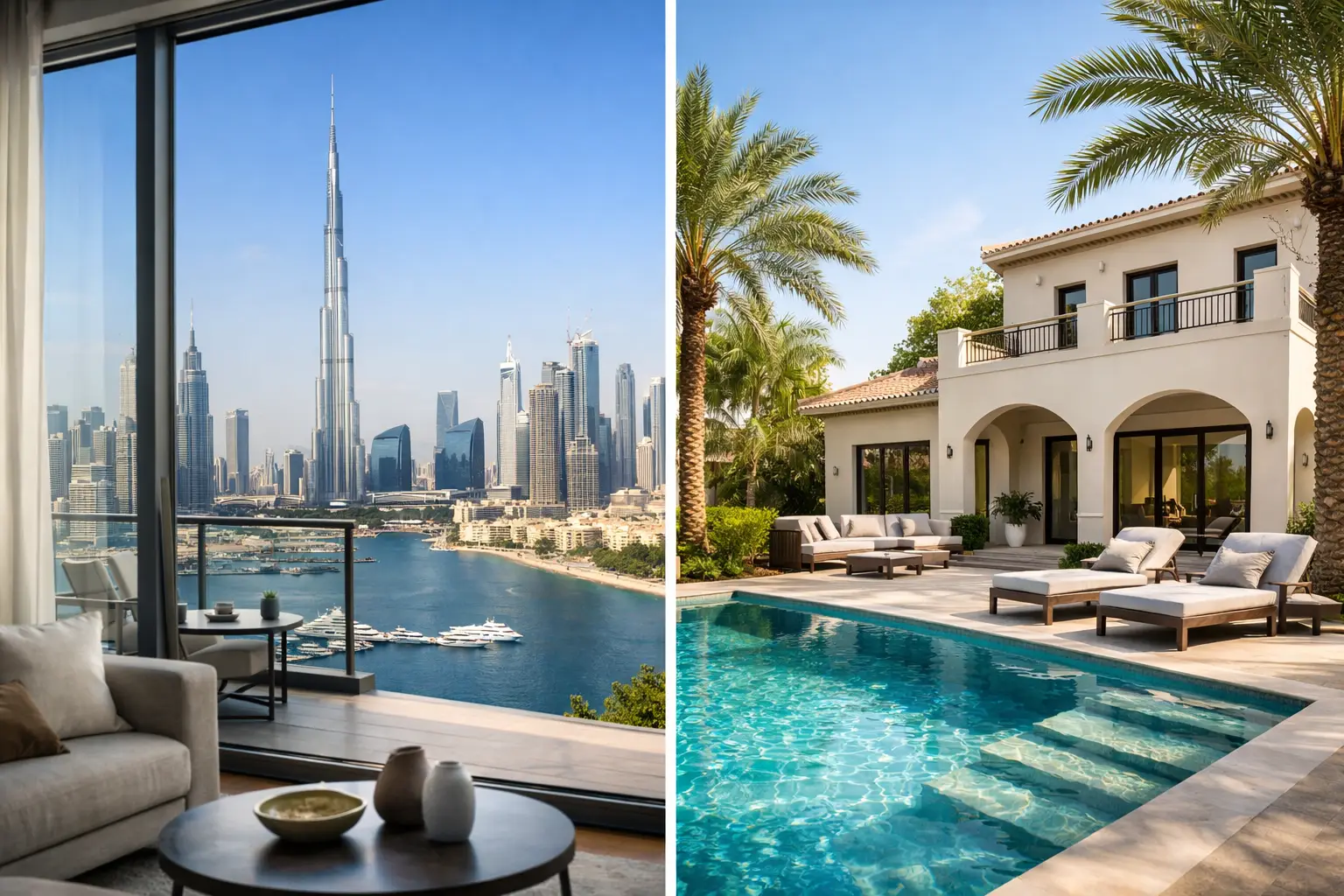
A Dubai home can be a morning walk to DIFC, a waterfront view after work, or a private garden where the weekend begins at your own pace. The apartment versus villa Dubai decision is not simply about bedrooms or square footage. It shapes your daily routine, your operating costs, the tenants you attract, and how your property may perform as a long-term asset.
For many buyers, the right choice becomes clearer when lifestyle and financial priorities are assessed together. Apartments often put residents close to business districts, retail, dining, and transit. Villas offer privacy, outdoor space, and room for a growing household. Both can be compelling in Dubai, but they serve different objectives.
Apartment Versus Villa Dubai: The Core Difference
An apartment is generally the more urban choice. It suits buyers and renters who value convenience, managed amenities, and access to established commercial and lifestyle destinations. A one-, two-, or three-bedroom apartment in communities such as Business Bay, Jumeirah Lake Towers, or Jumeirah Village Circle can provide a practical entry point into Dubai ownership while appealing to a broad rental market.
A villa is a more space-led decision. Private entrances, gardens, larger living areas, multiple parking spaces, and greater separation from neighbors are major advantages for families and buyers seeking a more independent lifestyle. Villas are often associated with master-planned communities where parks, schools, retail, and leisure facilities are part of the residential experience.
The trade-off is straightforward: apartments commonly offer a lower acquisition cost and less individual maintenance responsibility, while villas usually require a larger capital commitment and more hands-on attention. In return, a villa can offer the privacy and flexibility that many high-income households prioritize.
Start With How You Will Use the Property
A primary residence should support the life you actually lead, not only the property type you imagine owning. An apartment may be the stronger fit for an entrepreneur who travels frequently, a professional working near Downtown Dubai or Business Bay, or a couple who wants gym, pool, security, and concierge-style convenience without managing a large home.
For families, the equation can change quickly. A villa gives children more room, creates space for entertaining, and may accommodate a home office, staff room, or visiting relatives more comfortably. Buyers who expect their household needs to expand over the next five to ten years should consider whether an apartment will still feel practical after the initial excitement of a central location fades.
Location matters just as much as the building or villa itself. A well-positioned apartment close to employment hubs can save meaningful time every week. A villa in a family-oriented community may offer a calmer pace but involve longer commutes. There is no universal winner. The better property is the one that matches your preferred balance of access, space, and privacy.
The Value of Amenities
Apartment residents often benefit from shared amenities that would be expensive to replicate privately: fitness centers, swimming pools, children’s play areas, lounges, reception services, and controlled access. These features can strengthen tenant appeal, particularly in newer developments designed for professionals and international residents.
Villa communities may offer pools, parks, sports courts, walking paths, clubhouses, and community retail. The experience is different. Rather than living above the city, you are buying into a neighborhood environment. For some buyers, that sense of space and community is worth paying more for.
Compare the Full Cost, Not Just the Purchase Price
The headline price is only the first number to review. Buyers should assess the complete ownership profile, including registration expenses, financing costs where applicable, service charges, maintenance, insurance, furnishing, and vacancy assumptions if the property will be rented.
Apartments typically have service charges that contribute to the maintenance of common areas, security, facilities, and building systems. These costs vary considerably by project, amenities, location, and unit size. A premium tower with extensive facilities may command higher annual charges, so the net rental return should be calculated after those expenses rather than judged by gross rent alone.
Villas may have community fees, but owners can also carry more direct maintenance responsibility. Landscaping, air conditioning servicing, pool upkeep, pest control, roof repairs, appliances, and exterior improvements can become material costs over time. A well-maintained villa can preserve its appeal and protect value, but it requires a realistic annual maintenance budget.
For off-plan buyers, payment-plan structure is another important part of the comparison. Apartments are often available in a wider range of unit sizes and price points, which may make staged payments more accessible. Off-plan villas can offer a compelling path into emerging communities, although buyers should evaluate the developer’s delivery record, community infrastructure, future supply, and projected resale demand.
Rental Income and Tenant Demand
From an investment perspective, apartments frequently offer a deeper tenant pool. Dubai attracts professionals, couples, small families, and corporate tenants who want convenient locations and modern facilities. Studios, one-bedroom, and two-bedroom apartments can be easier to position for leasing because they align with a broad segment of the rental market.
That does not automatically make every apartment the better investment. A large number of similar units in one building or neighborhood can increase competition. Investors should look beyond advertised rent and assess unit layout, floor level, view, parking, building condition, handover timing, and the number of comparable homes likely to reach the market.
Villas often target a narrower but potentially more stable renter profile: families seeking multiple bedrooms, private outdoor space, and a long-term community setting. Leasing cycles may be less frequent when the right family settles in, which can support occupancy. However, the initial investment is generally higher, and a vacant villa can have a greater effect on annual returns.
The most useful metric is net yield, supported by realistic assumptions. Consider expected rent, service or community charges, maintenance, property management, furnishing costs, financing, and a provision for vacancy. A property that looks exceptional on a gross-yield basis may perform differently once operating costs are included.
Capital Appreciation Depends on Supply and Scarcity
Apartments and villas can both appreciate, but the drivers are not identical. Apartment performance is often influenced by connectivity, the quality of the development, nearby commercial activity, future towers, and the strength of the local rental market. A distinctive unit with a desirable view, practical floor plan, and trusted developer can stand out even within a high-density district.
Villa values are often tied to land scarcity, community reputation, plot size, upgrades, and the availability of comparable homes. In established family communities, limited supply can support demand for well-presented villas. Yet buyers should avoid assuming that every large home will command a premium. Layout, condition, landscaping, parking, proximity to roads, and community amenities all influence resale appeal.
Questions to Ask Before Choosing
Before reserving a property, clarify your holding period. A buyer planning to live in Dubai for two years may prioritize flexibility and ease of resale. An investor with a longer horizon may place greater weight on rental income, future community growth, and asset positioning.
Also ask whether you want a passive or active ownership experience. An apartment in a professionally managed building can be easier to oversee, especially for overseas investors. A villa may require more active maintenance coordination, though professional property management can reduce that workload and help protect rental income.
Finally, inspect the details that photographs cannot show. Review the community master plan, parking allocation, maintenance history for ready properties, unit orientation, noise exposure, storage, access roads, and the practical quality of finishes. In Dubai, a good address is valuable, but a well-chosen unit within that address can make the larger difference.
Make the Decision With a Clear Investment Brief
The best purchase starts with a brief that defines what success looks like. For a homebuyer, that may mean a short commute, room for children, and predictable monthly costs. For an investor, it may mean a target net yield, a preferred tenant profile, and a property that can remain competitive as new supply enters the market.
Brook Real Estate approaches this decision as both a lifestyle and asset-planning conversation. Comparing shortlisted apartments and villas by price per square foot, expected rent, operating costs, future supply, and resale positioning can turn a broad search into a disciplined acquisition plan.
Choose the apartment when proximity, managed living, and broad rental demand matter most. Choose the villa when privacy, family space, and long-term community living justify the additional capital and upkeep. The right Dubai property is the one that continues to work for your life and your financial objectives long after the keys are handed over.